
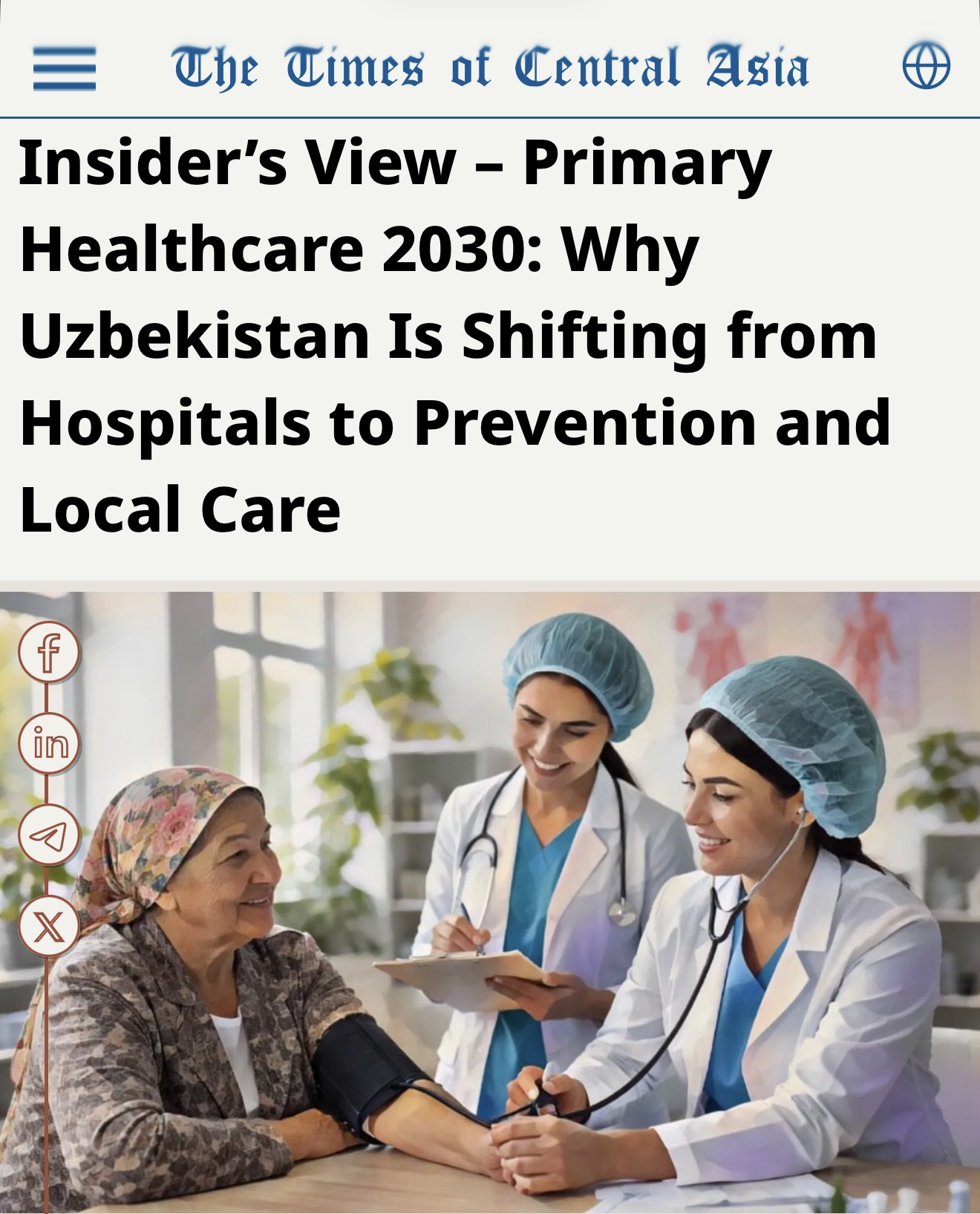
Uzbekistan’s healthcare system is shifting from a hospital-centric model to one that prioritizes primary healthcare and prevention as part of its 2030 reform agenda. This change aims to manage up to 85% of inpatient and 80% of outpatient needs at the local level, reducing the burden on hospitals and overall costs. The strategy, supported by the WHO and World Bank, focuses on early detection and treatment of noncommunicable diseases like diabetes and hypertension, strengthening family medicine, and improving financial protection through outpatient coverage. Institutional reforms and investments in primary care workforces are critical to ensuring sustainable Universal Health Coverage, echoing successful global models such as Thailand and Brazil. By emphasizing prevention and local care, Uzbekistan aims to deliver more efficient, equitable, and cost-effective healthcare outcomes.
For decades, health systems across the world have followed a familiar path: investing in hospitals, expanding specialized care, and treating disease when it becomes severe. Yet evidence from both high- and middle-income countries increasingly shows that this model is costly, inefficient, and poorly suited to today’s disease burden. Uzbekistan’s health reform agenda through 2030 reflects this global rethinking by placing primary healthcare and prevention at the center of the system.
The logic is straightforward. The more health problems are resolved at the primary care level, before complications arise, the less pressure there is on hospitals, and the lower the overall cost of care. This principle underpins the World Health Organization’s approach to Universal Health Coverage (UHC) and is now explicitly shaping Uzbekistan’s national strategy. According to the report, “A reformed service delivery system in Uzbekistan should be able to manage about 80% of the population’s outpatient and 85% of inpatient health needs at the primary health care/district level.”
The cost of a hospital-centered model
Noncommunicable diseases (NCDs) are the main driver behind this shift. In Uzbekistan, as in many countries in the WHO European Region, cardiovascular disease, diabetes, cancer, and chronic respiratory conditions account for the majority of premature mortality. WHO assessments note that the burden of these conditions is rising and that health systems built around inpatient treatment tend to intervene too late, when care is most expensive, and outcomes are poorest.
Economic estimates cited in national policy discussions place annual losses associated with NCDs at around $1 billion. These losses are not limited to public spending; they include foregone productivity, long-term disability, and avoidable premature deaths. Without early detection of hypertension, elevated blood glucose, and cholesterol at the primary care level, health systems end up financing complications rather than preventing disease.
Diabetes illustrates this dynamic clearly. International projections show a steady rise in adult diabetes prevalence in Uzbekistan through 2045. The most cost-effective interventions, including routine screening, lifestyle counseling, and continuous follow-up, are delivered through primary healthcare. Dialysis, stroke rehabilitation, and complex inpatient care are not.
Uzbekistan 2030: from strategy to system design
Uzbekistan’s National Health System Strategy 2030 translates this logic into concrete system objectives. Developed with support from the World Bank and international partners, the strategy emphasizes integrated service delivery, strengthened family medicine, and expanded preventive services throughout the country.
A central performance objective is resolving the majority of patient needs at the primary healthcare level. This is not about convenience alone; it is about reallocating resources toward early intervention and chronic disease management, while allowing hospitals to focus on cases that genuinely require inpatient treatment.
Prevention is being operationalized through specific policy instruments. The strategy includes expanded access to preventive services and micronutrient support, particularly for children and vulnerable groups, with an expected reduction in the prevalence of selected infectious and noncommunicable conditions. This marks a shift from abstract commitments to prevention toward interventions with measurable public health impact.
Progress toward UHC provides additional context. According to WHO and World Bank reporting, Uzbekistan’s UHC service coverage index increased from the mid-50s in 2000 to the mid-70s by 2021, reflecting expanded access to essential health services. The next phase of progress depends less on hospital capacity and more on the quality, accessibility, and continuity of primary care.
Financial protection and primary care
Uzbekistan’s UHC commitments through 2027 include raising service coverage further and reducing out-of-pocket spending, which remains high by international standards. Such a reduction is unlikely without a strong primary care system and a clearly defined, guaranteed benefits package. Otherwise, households continue to rely on self-treatment, private services, or hospital admissions, all of which drive out-of-pocket costs upward.
Recent reforms to outpatient medicine coverage illustrate how primary care can improve financial protection. Under new arrangements, the State Health Insurance Fund reimburses essential medicines for priority NCDs at the primary healthcare level, initially piloted in Syrdarya region and now expanding nationwide. WHO Representative in Uzbekistan, Dr. Asheena Khalakdina, described this reform as one that “paves the way for greater affordability and equitable access to essential medicines” and noted its importance for improving treatment adherence and outcomes.
Institutional reform: making primary care the entry point
Regulatory reforms adopted in 2025 reinforce this strategic direction. A presidential resolution on healthcare reform outlines a reorganization of service delivery so that primary healthcare becomes the main entry point into the system, supported by updated referral pathways and financing mechanisms.
WHO Europe has described Uzbekistan’s reform trajectory as one that provides “practical guidance and timely recommendations on how to proceed with the health system reform rollout,” emphasizing the importance of sequencing, institutional clarity and workforce readiness.
Policy dialogues hosted by the Ministry of Health and WHO have also focused on human resources for health, particularly the training and deployment of family doctors and nurses, who are critical to effective community-level prevention and chronic disease management.
Global lessons: prevention works
Uzbekistan’s approach aligns closely with international experience. The Declaration of Alma-Ata, adopted in 1978, stated that primary healthcare “forms an integral part both of the country’s health system… and of the overall social and economic development of the community.”
Subsequent experience has reinforced this principle. Countries that invested consistently in primary care and prevention achieved sustained reductions in avoidable mortality and financial hardship. Thailand’s UHC reform, built on a strong primary care network and a guaranteed benefits package, sharply reduced out-of-pocket spending over two decades. Brazil’s Family Health Strategy demonstrated that team-based primary care with household outreach could significantly reduce infant mortality at the municipal level. Even highly digitalized systems, such as Estonia’s, show that continuity and coordination anchored in primary care improve efficiency and patient outcomes.
From hospitals to health
The lesson across countries and income levels is consistent: prevention and primary healthcare deliver durable health gains at a lower cost than hospital-centered systems. For Uzbekistan, Primary Healthcare 2030 is not a rejection of hospitals, but a rebalancing of the system. Hospitals remain essential, but only when primary care is strong enough to prevent avoidable admissions.
As WHO Europe leadership has repeatedly emphasized, achieving UHC requires sustained political commitment, integrated service delivery, and a focus on equity and quality across the life course. With NCDs driving the majority of deaths, continuing to prioritize hospital expansion without investing in primary care would mean paying more to treat consequences rather than causes. The shift toward prevention, early detection, and local care is therefore not only a health reform but a fiscal, social, and economic necessity.
Komila Mirkomilova
Leading researcher of ILLP