
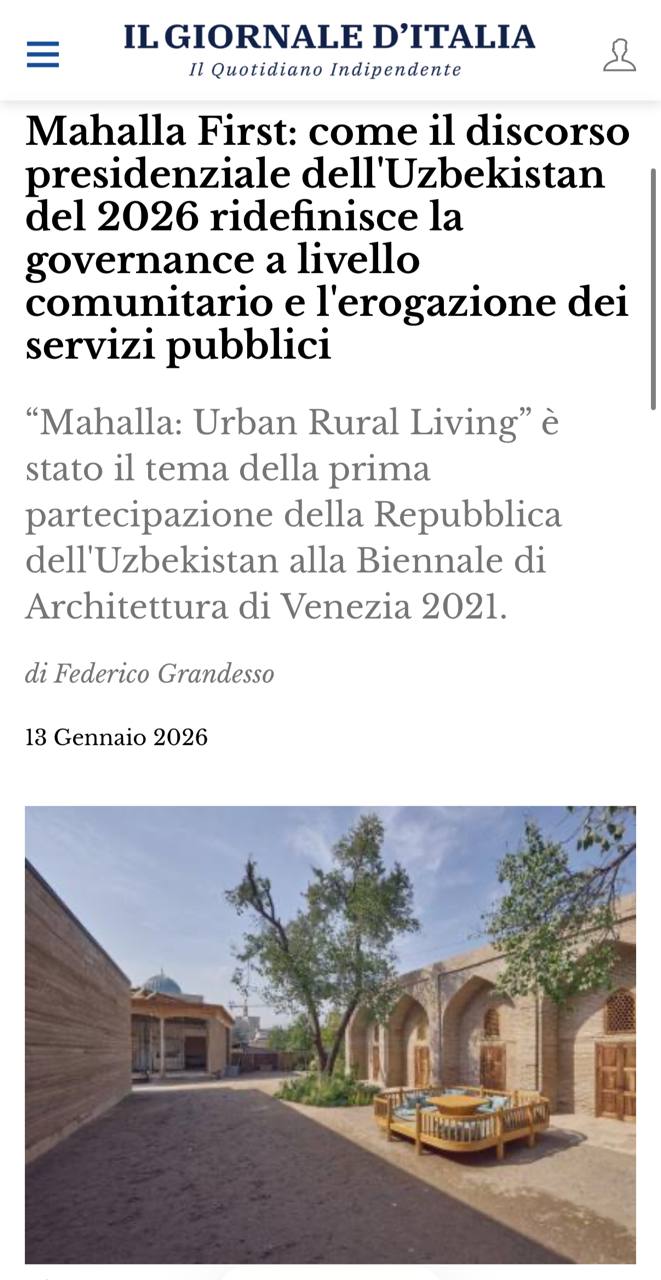
In recent years, under the leadership of the President of the Republic of Uzbekistan, Shavkat Mirziyoyev, the country has consistently implemented large-scale systemic reforms encompassing all key spheres of social, political, and socio-economic life. The democratic transformations underway have acquired a stable and irreversible character, reflected in the profound restructuring of public governance mechanisms, the expansion of citizen participation in decision-making processes, and a reassessment of the role of local-level institutions within the system of public authority.
In his Address to the Oliy Majlis and the people of Uzbekistan, the President outlined the key guidelines and priority directions for the country’s further development.[1] A central initiative within this Address was the declaration of 2026 as the Year of Mahalla Development and Society as a Whole. This decision indicates a transition to a new stage of institutional strengthening of community governance and social policy, emphasizing the growing importance of the mahalla as a foundational element of state-society interaction.
This initiative reflects the state’s intention to give a systematic and long-term character to reforms aimed at strengthening the role of the mahalla as a basic link in interaction between the state and citizens. The designation of a thematic year is not declarative in nature; rather, it предусматривает the implementation of a set of interconnected measures addressing social development, public service delivery, support for vulnerable population groups, and the expansion of citizen participation in resolving issues of local significance.
In this context, the mahalla is viewed as a universal platform for the implementation of government programs, coordination of the activities of public authorities, and the formation of sustainable communities. Strengthening the role of the mahalla makes it possible to ensure the targeted provision of social assistance, improve the effectiveness of local governance, and create conditions for more active public involvement in processes of social development.
Historically, in Uzbekistan the mahalla has developed as a stable center of cultural life and an effective institution of civil society. Over centuries, it has served as a unique element of civil society, ensuring not only social cohesion but also the continuity of traditional mechanisms of social interaction.[2]
The core principles guiding the activities of the mahalla in Uzbekistan include legality, the primacy of human rights, freedoms, and lawful interests, democratic governance, transparency, social justice, autonomy in addressing issues of local significance, community mutual assistance, social partnership, and respect for local customs and traditions. Citizens, regardless of gender, race, nationality, language, religion, social origin, beliefs, or personal and social status, enjoy equal rights to participate in self-governance.
The role and significance of the mahalla have historically been of particular importance in the careful preservation and intergenerational transmission of national and universal values, cultural traditions, established ways of life, patterns of thinking, and spiritual orientations of Uzbekistan’s multiethnic society. It is within the space of the mahalla that norms of mutual respect, solidarity, and social responsibility have been formed, norms that continue to serve as an essential moral and ethical foundation for social development today.
In recent years, the role of the mahalla has undergone significant transformation, acquiring a clearly defined institutional character. Under current conditions, this institution functions as a multifunctional social system that combines socio-democratic, cultural and spiritual, and territorial-administrative functions. The mahalla organically integrates traditional values of social interaction with modern instruments of public governance, enabling it to serve as a stable and effective intermediary between the state and citizens.
The mahalla has assumed a particularly important role within Uzbekistan’s system of targeted social assistance. As a result of consistent and purposeful reforms, it has evolved into one of the key mechanisms for implementing state social policy at the local level. Today, more than one hundred types of social services are delivered through mahalla structures, including subsidies, compensation payments, social assistance measures, as well as programs of preferential lending and employment support.
The outcomes achieved in this sphere have not only clear social significance but also substantial economic implications. Over the past year, more than 8.5 million citizens were removed from the register of low-income households, the poverty rate declined from 8.9 to 5.8 percent, unemployment was reduced by nearly half, and more than 5 million people obtained sustainable sources of income.[3] These indicators demonstrate the growing effectiveness of targeted social support mechanisms and confirm the increasing role of the mahalla as an instrument of socio-economic stabilization.
These processes indicate the emergence in Uzbekistan of a new model of social governance, within which the mahalla becomes not only an object of state policy but also an active subject of socio-economic development. Strengthening its institutional capacity contributes to greater precision in social assistance, more rational use of resources, and increased public trust in the reforms being implemented.
The strategic significance of the mahalla is determined by its ability to exert a systematic influence on the formation and quality of human capital. By relying on the social authority of community elders, the professional capacity of educators, the managerial responsibility of mahalla chairpersons, and the entrepreneurial initiative of residents, conditions are created for addressing socially significant challenges in a comprehensive manner. These include poverty reduction, the prevention of corrupt practices, the mitigation of family conflicts and divorces, and the reduction of crime at the local level.
An important factor enhancing the effectiveness of these processes is state financial and institutional support aimed at expanding the capacities of mahallas in the sphere of social development. The implementation of relevant programs contributes to the creation of a favorable environment for the development of mass sports, the revival of traditional crafts, support for scientific and educational activities, and the introduction of innovative solutions at the community level. As a result, the mahalla is gradually transforming into a space for comprehensive personal development and social engagement.
In strategic terms, this direction is viewed as one of the key resources for the formation of the New Uzbekistan. Within this model, the sustainability of the state is directly linked to the well-being of local communities and the quality of life of each citizen. Strengthening the institution of the mahalla therefore represents not only an element of social policy, but also a fundamental foundation for long-term stability and steady national development.
At present, particular attention is focused on increasing the role of the mahalla in the socio-economic life of the country. To identify and address social issues that most concern the population, a practice has been established whereby mahalla chairpersons organize public discussions and hear reports at mahalla council meetings from the heads of relevant government bodies and organizations. In addition, mechanisms such as “mahalla-based oversight” and the “request of the mahalla chairperson” are actively functioning, contributing to greater accountability and responsiveness at the local level.[4]
Overall, the 2026 Presidential Address of the Republic of Uzbekistan reflects a consistent continuation of the policy aimed at strengthening the role of the mahalla within the system of state and public governance. The priorities outlined in the Address indicate an effort to build a sustainable model of interaction between the state and society, in which key socio-economic challenges are addressed at a level максимально close to the population.
The experience of recent years demonstrates that the expansion of mahalla powers and its institutional strengthening contribute to the achievement of significant socio-economic outcomes. Reductions in poverty levels, growth in employment, and expanded access to social services confirm that the mahalla level of governance possesses substantial potential for addressing social development objectives.
Particular importance is attached to the influence of the mahalla on the formation of human capital. The involvement of local community representatives, including elders, educators, entrepreneurs, and mahalla leaders, enables more effective solutions to issues related to social prevention, family support, employment, and social stability. In this context, the mahalla functions not only as an administrative structure but also as a social environment that creates conditions for sustainable personal development.
The development of the mahalla as an institution of citizen self-governance contributes to strengthening social resilience, improving the quality of life of the population, and forming a balanced model of state development in which the well-being of individual communities is regarded as a necessary condition for the overall progress of the country.
Literature
1. Mirziyoyev, Sh. Address of the President of the Republic of Uzbekistan, Shavkat Mirziyoyev, to the Oliy Majlis and the People of Uzbekistan, December 26, 2025. https://president.uz/ru/lists/view/8834. Ш.Мирзиёев. Послание Президента Республики Узбекистан Шавката Мирзиёева Олий Мажлису и народу Узбекистана. 26.12.2025. https://president.uz/ru/lists/view/8834.
2. The mahalla is a unique institution of civil society in Uzbekistan.¹ Turgunova, D. (2025). The Role of the Mahalla Institute as a Social Structure in the New Uzbekistan. Society and Innovations, 6(4/S), 580–584. https://doi.org/10.47689/2181-1415-vol6-iss4/S-pp580-584. Махалля – уникальный институт гражданского общества в Узбекистане. https://uzbekistan.org.ua/ru/news/5046-makhallya-unikalnyj-institut-grazhdanskogo-obshchestva-v-uzbekistane.html. Тургунова, Д. (2025). Место института махалля как социальной структуры в Новом Узбекистане. Общество и инновации, 6(4/S), 580–584. https://doi.org/10.47689/2181-1415-vol6-iss4/S-pp580-584
3. A. Aminova. Strategic Resource for Further Development, January 5, 2026. https://parliament.gov.uz/ru/news/post-1030. А.Аминова. стратегический ресурс дальнейшего развития.05.01.2026. https://parliament.gov.uz/ru/news/post-1030.
4. D.Kambarova. The Mahalla Institution in the New Uzbekistan Plays an Important Role in Supporting Citizens’ Social Activity, March 27, 2025. https://gk-usbekistan.de/ru/2025/03/27/. Д.Камбарова. Институт махалли в Новом Узбекистане играет важную роль в поддержке социальной активности граждан.27.03.2025г. https://gk-usbekistan.de/ru/2025/03/27/%
[1] Mirziyoyev, Sh. Address of the President of the Republic of Uzbekistan, Shavkat Mirziyoyev, to the Oliy Majlis and the People of Uzbekistan, December 26, 2025. https://president.uz/ru/lists/view/8834. Ш.Мирзиёев. Послание Президента Республики Узбекистан Шавката Мирзиёева Олий Мажлису и народу Узбекистана. 26.12.2025. https://president.uz/ru/lists/view/8834.
[2] The mahalla is a unique institution of civil society in Uzbekistan.¹ Turgunova, D. (2025). The Role of the Mahalla Institute as a Social Structure in the New Uzbekistan. Society and Innovations, 6(4/S), 580–584. https://doi.org/10.47689/2181-1415-vol6-iss4/S-pp580-584. Махалля – уникальный институт гражданского общества в Узбекистане. https://uzbekistan.org.ua/ru/news/5046-makhallya-unikalnyj-institut-grazhdanskogo-obshchestva-v-uzbekistane.html. Тургунова, Д. (2025). Место института махалля как социальной структуры в Новом Узбекистане. Общество и инновации, 6(4/S), 580–584. https://doi.org/10.47689/2181-1415-vol6-iss4/S-pp580-584
[3] A. Aminova. Strategic Resource for Further Development, January 5, 2026. https://parliament.gov.uz/ru/news/post-1030. А.Аминова. стратегический ресурс дальнейшего развития.05.01.2026. https://parliament.gov.uz/ru/news/post-1030.
[4] D. Kambarova. The Mahalla Institution in the New Uzbekistan Plays an Important Role in Supporting Citizens’ Social Activity, March 27, 2025. https://gk-usbekistan.de/ru/2025/03/27/. Д.Камбарова. Институт махалли в Новом Узбекистане играет важную роль в поддержке социальной активности граждан.27.03.2025г. https://gk-usbekistan.de/ru/2025/03/27/%
Aripov Komiljon Mersaidovich
Head of the Sector for Analysis of the Effectiveness of Constitutional Development and Public Administration at the Institute of ILLP