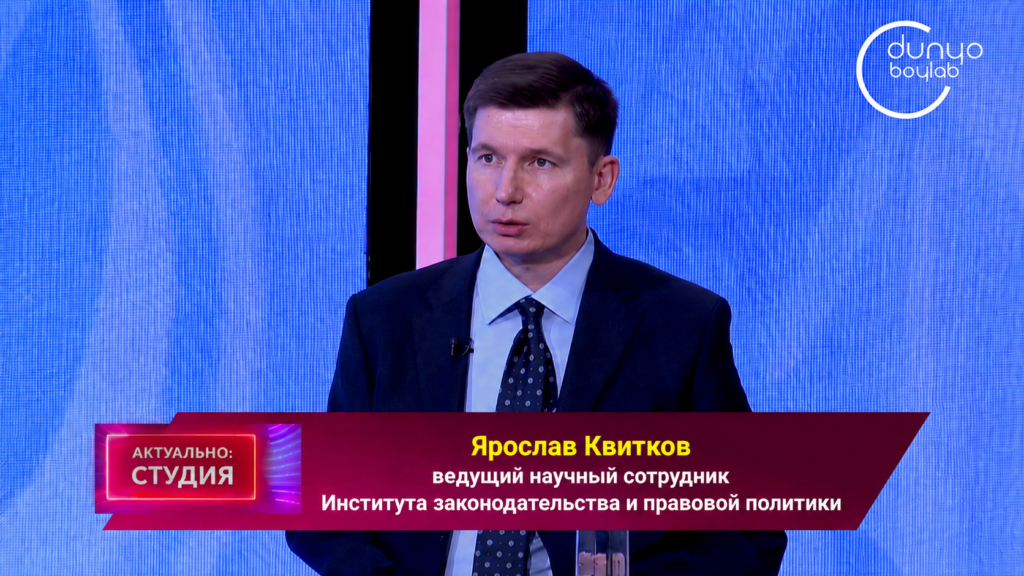
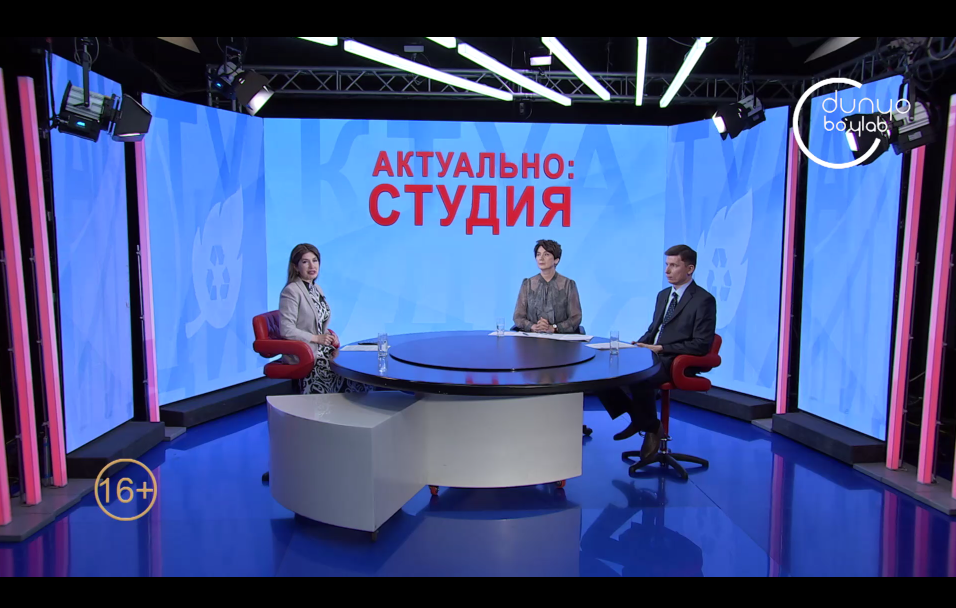
On 3 August 2026, researchers of the Institute of Legislation and Legal Policy under the President of the Republic of Uzbekistan, G.R. Malikova and Ya.M. Kvitkov, took part in the “Aktualno Studio” television programme on the “Dunyo Bo‘ylab” TV channel. The programme was dedicated to the videoconference meeting chaired by the President of the Republic of Uzbekistan on creating a new environment in mahallas and reorganising the activities of the “mahalla seven” on new principles.
During the programme, the participants discussed enhancing the responsibility and initiative of mahalla chairpersons and members of the “mahalla seven”, providing scientific and methodological support for their activities, improving the effectiveness of the use of resources allocated to mahallas, as well as strengthening the role of the mahalla chairperson in addressing the development needs of the respective territory. Particular attention was paid to the measures outlined at the meeting to provide mahalla chairpersons with additional instruments for developing social infrastructure, as well as to the organisational and legal aspects of transferring certain public services to the mahalla level.
The discussions emphasised the need to move from merely recording the problems of the population to their systematic and results-oriented resolution, clearly delineate the functions and responsibilities of the members of the “mahalla seven”, improve inter-agency coordination, and introduce scientific approaches into mahalla governance. Particular emphasis was placed on the need to preserve clearly defined powers and responsibilities of state bodies when bringing public services closer to the population and organising their delivery at the mahalla level.
In this context, it was noted that the implementation of the tasks set by the President is aimed at shaping a new model of mahalla operation, in which the powers and resources provided are reinforced by personal responsibility, initiative and a focus on tangible results. The consistent implementation of these approaches will help improve the coordinated work of the “mahalla seven”, strengthen the role of the mahalla chairperson in organising activities within the respective territory, and ensure more prompt, targeted and effective solutions to the issues affecting the population.